HolyDev Development: Websites, Bots and CRM for Affiliate Teams
HolyDev is the part of HolyTraff where our team takes on development for outside clients. Frontend and backend developers, DevOps engineers and designers build websites, bots, internal tools and infrastructure for affiliate teams, media buyers and iGaming brands. This guide explains how to describe the task, choose a first stage and agree a result that can be checked. Bring a new project or a problem in an existing process. Explain who needs the tool, what it should change and which constraints the team already knows.
These are the same people who build the HolyTraff website, the HolyApps apps and the media's internal services. We work in the same niche as our clients, so a task like “a prelander for a geo with a tracker and Telegram alerts” does not need explaining from scratch.
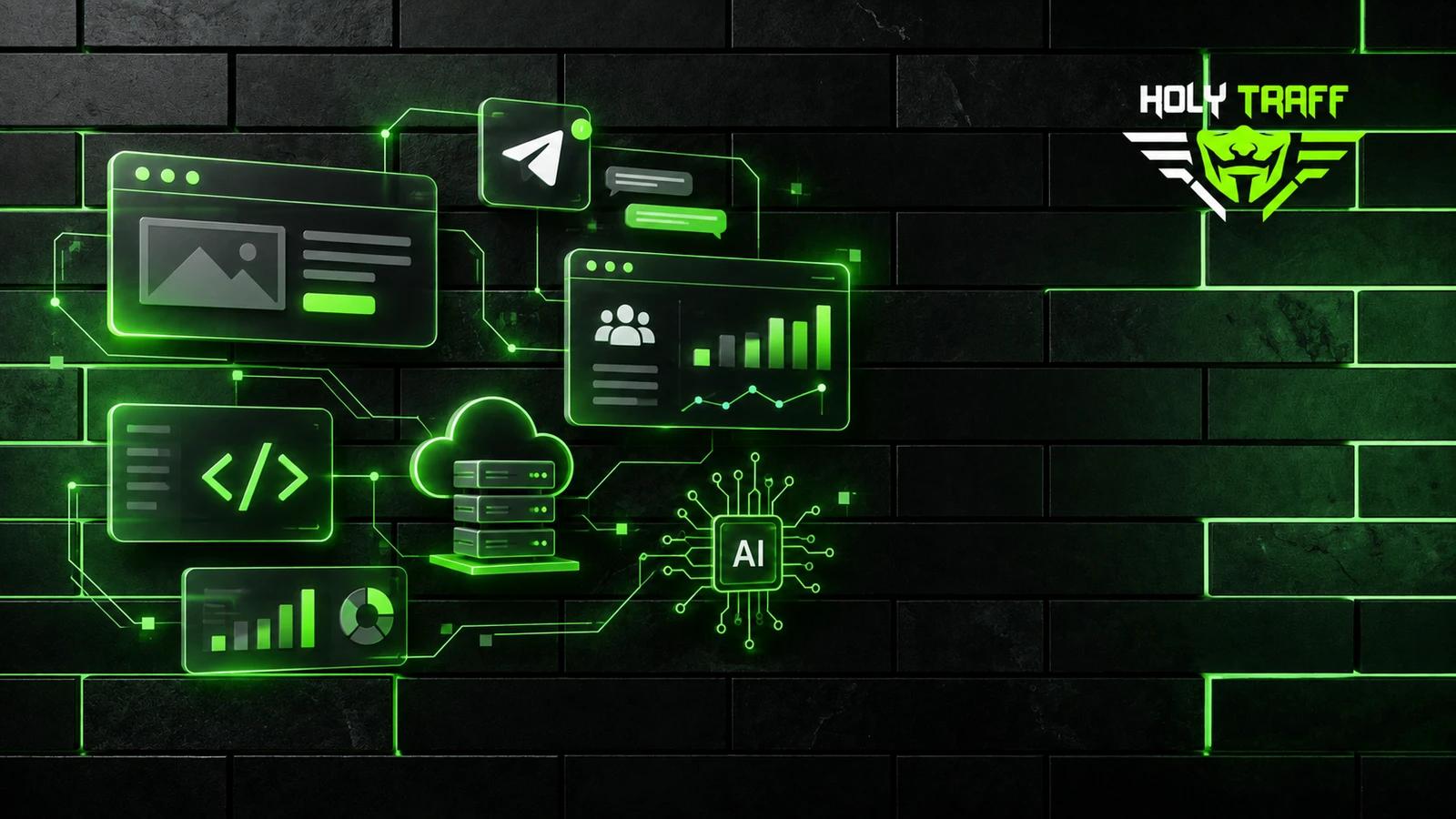
What we do
Websites for traffic launches
Landing pages and prelanders for an offer and a geo, white pages (full websites with their own content), and landing pages and stores on Shopify. Responsive layouts, fast pages and several languages when you need them.
Telegram
Custom bots, Mini Apps inside Telegram and autoposting to channels. A bot can take requests, answer common questions and send reports and alerts to your team.
CRM and internal tools
A CRM built around your team's process: requests, leads, partners, tasks and access in one place. We fit the system to your workflow instead of fitting your team to an off-the-shelf product.
Trackers and monitoring
We set up trackers, postbacks and conversion data between the tracker, the affiliate program and ad accounts.
AI and MCP
We connect Claude and ChatGPT to your company's data through MCP. The assistant gets access to the systems it needs and works by your rules: it looks up data, prepares reports and handles routine actions.
DevOps and servers
Server setup, Docker, CI/CD, monitoring, backups, Cloudflare and infrastructure migrations. We connect domains and SSL, separate development and production environments and set up deployments without manual steps.
Frontend and interactive content
Interactive pages and mechanics: quizzes, game elements and animations. We make sure they run fast on phones and do not slow the page down.
Design
UI/UX for landing pages and apps, interface mockups and ad creatives. Creatives come from HolyStudio.
Audits and maintenance
We review existing projects for loading speed, security and code quality, and take projects on for maintenance: changes, updates, monitoring and bug fixes.
How the work goes
- You describe the task and send the materials.
- We clarify the details and propose a solution, price and timeline.
- We agree on a mockup or prototype if one is needed.
- We build it and show progress along the way.
- We launch and hand over access, code and instructions.
- Support after launch is agreed separately.
What to send for an estimate
| What we need | What to include |
|---|---|
| Task | What needs to be built and what counts as done |
| Examples | Links to similar solutions and what you like about them |
| Geo and languages | Countries, interface languages and any ready texts |
| Integrations | Tracker, CRM, payment systems, Telegram, ad accounts |
| Access and materials | Domains, hosting, logos, mockups and texts |
| Timeline | Your target launch date and what it depends on |
If some of this is not settled yet, start with the task. We will work out the rest in the chat.
What we agree on before starting
- The scope of work and what the result includes.
- Price and timeline, set individually for each task.
- Who owns the code, domains and access after handover.
- How changes are handled and support after launch.
Development does not guarantee ad account approval, conversions or a return on spend: the result depends on the offer, the traffic and the campaign setup. We build projects with the rules of the platforms they will run on in mind.
How to start
Message the HolyTraff team with a short description of your task. Price and timeline are agreed individually.
Turn an idea into a task that can be checked
Start with a situation that needs to change. Perhaps the team manually transfers requests between systems or cannot identify where events stop arriving. These are example scenarios for a brief, not a promise of ready-made integration with any service. Describe the current process, participants and an outcome that would help them work.
Identify what the first launch actually needs. If you ask for a new website, CRM, bot and automated reports all at once, the discussion can easily sprawl. It is more useful to define the main scenario and its dependencies, then note later stages separately. The team will propose a specific implementation order once the request is clarified.
A completion criterion should describe an action and a visible result. A “convenient CRM” sounds nice but gives no grounds to accept the work. “An employee with the specified role creates a request, changes its stage and sees its history” can be checked; this illustrates useful wording rather than specifying a standard HolyDev product.
Explain existing constraints: current systems, available data, language requirements, user roles and dependencies on external APIs. If there is no documentation, say so. Uncertainty can be investigated, while a hidden constraint tends to surface at the least convenient moment.
Check the handover and post-launch arrangement
For a website, follow the main journey on a phone and computer. For a bot, check entry, commands and responses in the agreed scenarios. For an integration, confirm that the specified fields and events arrive and repeated submissions do not create unexplained duplicates; the actual checks depend on the assignment.
Separate progress demonstrations from acceptance. A demonstration shows development progress, while acceptance compares the result with agreed requirements. Name the person on the client side who can sign off the work and collect comments from everyone else. One agreed set of feedback is more useful than several contradictory messages.
At handover, clarify where code, domains, working access and instructions are held. Who pays for external services, and who can continue the work after the project ends? Settle these answers before starting: development and owning the infrastructure are related, but they are not the same thing.
For AI and MCP, define available information and permitted actions separately. The assistant needs to know where it only reads and where an action requires confirmation. The specific systems, permissions and scenarios are discussed separately in each project. We do not promise automatic access to any data.
Post-launch support is agreed separately. Discuss how to report bugs, what counts as a new request and how updates are planned. Do not call every future feature a fix: that makes the work harder to assess for both the team and the client.
Questions about HolyDev
Can I come with an existing project?
Yes, HolyDev takes projects on for audits and maintenance. Send a description of the project, the problem and the available materials; the scope of the review, later changes and terms are discussed separately.
Do I need a ready specification?
You can start with the task, examples and the result you want. If some requirements are unknown, list them as questions: they can then be investigated separately, and an assumption will not turn into an agreed feature.
Are development and support priced in the same way?
There is no single rate. Price, timeline, handover scope and support are set for each specific task, so confirm them before work begins.
Does a new landing page guarantee advertising payback?
No. A technical solution can be checked against agreed requirements, while campaign economics are assessed separately based on the offer, audience, source and actual events.
Start with a process that needs improvement
HolyDev brings together development and infrastructure services that can be discussed around an affiliate team’s task. For the first conversation, prepare the current process, the change you want, examples and constraints. Then agree on scope, acceptance criteria, ownership of the result and support. This order gives you a working solution with clear boundaries. Otherwise the project drags on endlessly, with every new request somehow turning out to be “that one small change”.