Empire of Success Rome: Three Brands, Booths and Merchandise
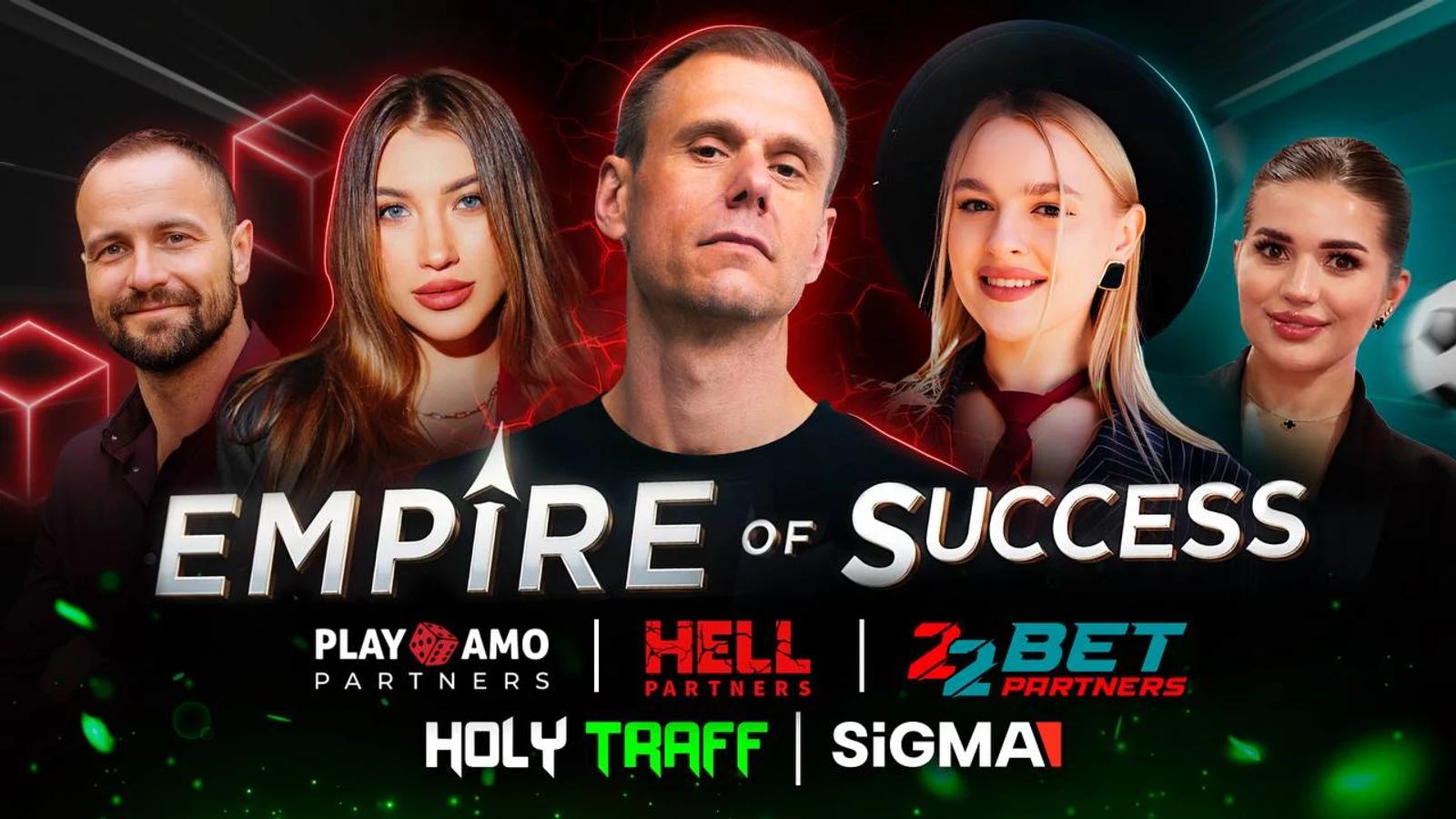
Three brands share the Empire of Success title, but the Rome episode gives each a different presentation: 22Bet Partners through continuity, Playamo Partners through a private-club concept and HELL Partners through a detailed merchandise story. HolyTraff published the recording on December 17, 2025. Beyond the party footage, its most useful material concerns how a brand connects a booth, a conversation and something a guest takes home. Here we examine those specific choices, while keeping promotional claims separate from independently demonstrated business results.
22Bet Partners: a collection that continues between events
The first interview begins around 01:11. A 22Bet Partners representative describes meeting existing affiliates, finding new partners and discussing traffic. Those are the team’s stated objectives, rather than a published account of contracts completed at the exhibition.
The conversation then moves to the bears displayed at the booth. The representative and host describe a collectible approach, with a racing-themed bear at this event and the possibility of different characters at later conferences. That is a brand’s proposed continuity mechanism, not evidence of an official Formula One partnership or a guarantee that every future collection was produced.
The useful design idea is that the object can refer to more than one visit. In our editorial reading, a recurring character gives the next encounter a recognisable starting point. The episode does not measure whether that familiarity improves conversion, so the mechanism should be discussed without inventing an effect size.
The representative also talks about transparent reporting, long relationships and the company’s market presence. Broad statements about compliance across Africa cannot establish the legal position of a product in each country. For a prospective partnership, the practical next question concerns the exact product, jurisdiction and agreed reporting process, rather than treating a regional claim as a complete answer.
Playamo Partners: making the private-club idea tangible
Around 04:56, the host introduces the House of Playamo Partners concept. She describes a code of honour and tailored partnerships, then shows an interaction in which visitors write what honesty means to them. The recording gives a concrete example of the booth’s theme, without providing a complete contractual definition of those values.
Writing by hand is an intentional contrast with the screens surrounding a digital business. Guests leave comments and contact details, while a prize is mentioned for an original contribution. That is a historical event mechanic, not an invitation this article renews for current readers.
The host also points to continuity between people appearing in the booth’s video and the printed presentation. Her positive reaction concerns recognisability across the materials. It does not establish that live-action footage always performs better than animation, AI-generated visuals or another production method.
For an editorial comparison, the question is whether the same idea survives across the touchpoints. Does the greeting match the invitation, and does the conversation explain what the written value means in practice? The episode makes that question visible, but a polished private-club atmosphere cannot independently prove a supplier’s honesty or service quality.
HELL Partners: an agency explains the merchandise system
The HELL discussion begins around 09:10. The agency representative, addressed as Ola, explains that the team works on the brand’s presentation, including booth design, merchandise and social content. She distinguishes designing the stand from constructing it, which helps clarify the actual scope of the work she is describing.
The Rome collection centres on family and a mafia-film aesthetic, with references to The Sopranos. The speaker presents the theme as a creative choice for the Italian setting and as a development of earlier event merchandise. Those references describe the concept; the recording does not establish licensing arrangements with a television rights holder.
One specific element is the use of QR codes connecting clothing with the brand’s Instagram and a themed playlist. The earlier Lisbon version is described as having a different musical reference, while Rome changes the soundtrack to suit its concept. This is a more precise explanation than simply calling the collection exclusive: the physical object leads to another piece of the presentation.
The speaker also describes a hoodie, packaging, a scarf or twilly, photographic material, a luggage tag and a power bank. Some items are presented as limited partner gifts, while others are described as more widely available at the stand. These distinctions matter because limited distribution and useful everyday objects serve different purposes, even within one merchandise programme.
A story about a visitor returning for a power bank illustrates perceived usefulness in the speaker’s account. It is not an independent battery test or evidence that competing products are defective. Likewise, claims about quality and previous items selling out remain the agency’s description of its own work.
What the three approaches actually let us compare
The interesting comparison is between the roles assigned to the materials. The bear collection introduces continuity, the Playamo writing activity creates a conversation around a stated value, and the HELL collection connects an event theme with objects and digital content. This is an editorial interpretation grounded in the explanations, rather than a ranking of the three programmes.
| Presentation in the episode | Concrete mechanism | Question to check afterwards |
|---|---|---|
| 22Bet Partners | Recurring collectible character | Do partners recognise the continuing story? |
| Playamo Partners | Handwritten comments about honesty | Does the conversation explain the promised value? |
| HELL Partners | Themed objects with QR-linked content | Does the object remain useful or interesting after the event? |
Those follow-up questions are proposed evaluation criteria, not results supplied by the recording. A company would need its own observations or agreed measures to answer them. The number of items handed out would also be a different measure from the number of qualified follow-up conversations.
A later conversation with Stefan briefly returns to recruitment, client meetings and speaking engagements. It adds another reason people attend the same exhibition: their task may be hiring or professional visibility rather than buying traffic. That difference is worth remembering before assigning every guest the same commercial goal.
The party closes the story, without measuring every outcome
Around 19:59, the host moves from the exhibition to the Empire of Success party. SiGMA’s official event announcement places the joint 22Bet, Playamo and HELL evening at Atlantico Live on November 4, 2025. That event date is separate from the December publication of the HolyTraff episode.
The original description names Armin van Buuren and promotes attendance above 3,500. HELL Partners’ own public recap repeats the 3,500-plus figure. We report that as the organizers’ claim, not an independently audited door count or a measure of contracts generated by the evening.
The party gives the three brand presentations a shared ending through music and social contact. The camera can convey excitement and the speakers can describe their intentions. Neither supplies the campaign data needed to establish that this was the most profitable event or that every guest formed a useful partnership.
Original source: Telegram
FAQ about the Rome Empire of Success episode
Is this one brand presented three ways?
The episode identifies three programmes: 22Bet Partners, Playamo Partners and HELL Partners. It links their presentations through a joint event, without establishing a shared corporate structure.
Can the limited merchandise still be obtained?
The discussion describes distribution at the historical event. It does not establish current stock, eligibility or a continuing giveaway, and this article does not promise access.
Does the party’s attendance prove the branding worked?
It is an organizer-reported attendance claim. Evaluating a particular branding objective needs a relevant measure, such as recognition or qualified follow-up, rather than substituting one large number for every outcome.
Conclusion: follow the idea beyond the booth
The Rome episode is useful when it explains a concrete choice: a recurring bear, a handwritten response, a playlist or a limited collection built around a theme. Those details show how the presenters wanted an encounter to continue after the exhibition. Treat that intent as the starting point for evaluation, not proof of success. The next useful step is to identify what the object or interaction should achieve and check whether partners actually experienced it that way.



Comments from Telegram
Open in TelegramTo write, sign in to Telegram in the box above. If a comment does not send, sign out and sign in again with your own account.