Making Your Website Visible in AI Search: Practical Checks
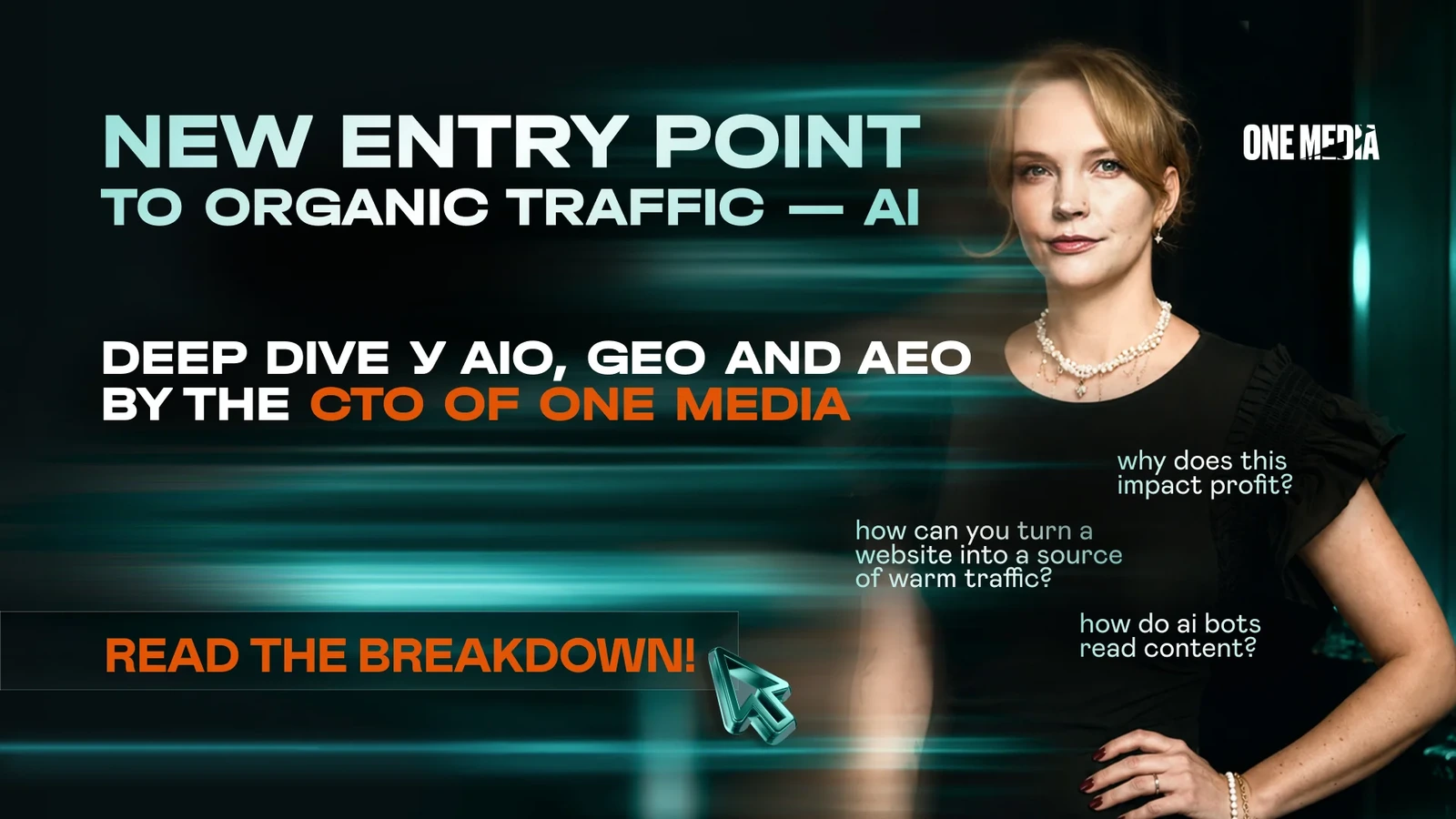
Your website may answer a question better than competing pages, yet your team cannot find it in AI responses. It is tempting to reach for another optimisation acronym, although checking access and the actual answer is a better starting point. In HolyTraff’s interview published on 25 May 2026, Ella, introduced as One Media’s CTO, explained AIO, GEO and AEO to media buyers. We preserve her approach and illustrations, then add clearly identified editorial corrections from official documentation checked on 15 October. The aim is a testable workflow.
Ella’s explanation of AIO, GEO and AEO
The original interview introduced Ella as the head of One Media’s technical infrastructure, with more than 200 specialists in the holding company. Her responsibilities were described as covering integrators, software developers and the Android and iOS application project One Apps. These are details from the introduction at publication, rather than a current independent headcount check.
Her central point was: “They don't replace classic SEO; they complement it.” She used AIO for technical access, GEO for helping a generative system find an answer, and AEO for clear answers and a recognisable voice. That is a useful way to divide responsibilities, as long as it stays identified as the interviewee’s explanatory framework.
Ella recommended starting with access, then moving to content and sustained brand work. There is no point improving a page for a bot that cannot retrieve it. One editorial note: these labels do not describe a single mandatory protocol shared by every AI service.
Checking access without opening every door
First decide what you want: search visibility, inclusion in a particular service’s answers or availability for training. These are different purposes, and the site owner should decide which access to permit. “Allow every AI bot” is too broad to apply as an infrastructure policy without understanding each agent’s role.
According to OpenAI’s crawler documentation, checked on 15 October, OAI-SearchBot supports search and GPTBot concerns potential training; their settings are independent. Google-Extended has no separate HTTP user-agent string and does not control inclusion in Google Search. Treating these names as equivalent search visitors is therefore misleading.
For an editorial audit, choose a specific page and ask a technical specialist to check its response, content and access through protective services. A 200 response does not prove the expected article was returned rather than a placeholder. Confirm that the bot receives the same material an ordinary visitor reads.
Ella advised buyers to understand logs and distinguish 200, 404 and 500 responses. That is useful as a shared language with developers, rather than a requirement for every buyer to become a server administrator. A good issue report identifies the page, time, observed result and expected behaviour.
Preparing a useful answer rather than an SEO ritual
Ella’s content advice focused on direct answers, lists, tables and understandable language. Start with the reader’s question, answer it and explain the conditions that matter. Someone comparing products needs differences, limitations and suitable use cases, rather than a long introduction about why choosing carefully is important.
For AI Overviews and AI Mode, Google requires no special markup or separate AI file; standard SEO foundations remain relevant. That statement concerns those Google features specifically. It neither guarantees inclusion nor proves that a table or FAQ will make every generative service cite your page.
The original One Media interview illustrations are preserved below. They illustrate the interviewee’s approach, rather than an official specification from search providers; read their technical claims alongside the editorial clarifications in this article.


Each format should do a real job. A table helps when alternatives can be compared using the same properties, while an FAQ should resolve questions still left open. If a connected paragraph explains the subject clearly, do not split it into artificial answers for an imagined algorithmic preference.
Measuring results and interpreting growth forecasts
In the interview, Ella forecast:
- profit growth of 30-50% over 6-12 months;
- conversion increasing by at least 20%;
- organic traffic growing by roughly 50% or more;
- citation share rising by around 18%;
- conversion up to four times higher;
- scaling that is 40-80% more efficient;
- effects within 3-6 months;
- very little fraud.
These figures remain statements made by the interviewee on 25 May 2026. The original material does not provide a sample, calculation or underlying dataset allowing them to be validated as general forecasts. They should not become a financial planning assumption or a promise to a client simply because they appeared in an interview.
An editorial measurement plan starts with a fixed set of questions and pages. Record the service, date, exact query, returned answer and whether a source link appears. Separate a brand mention, a page citation and an actual visit, because each tells you something different.
When visits appear, compare them with available analytics and the quality of subsequent enquiries. An unrecognised source does not establish that no influence occurred, while a single favourable mention does not establish a sustainable channel. Agree a review date and the observations to collect instead of promising a particular payback date.
Keep unsuccessful observations as well. A log containing only attractive citations creates an exaggerated picture of progress. Applying the same procedure to the whole agreed question set makes it easier to distinguish promising pages from cases where the team simply needs more evidence.
Dividing work between buyers and technical staff
Ella suggested a small experimental budget and moving resources between content and technical tasks according to results. A bounded test is a practical way to do that. Define the pages, owners, starting conditions and changes you intend to examine before the team begins work.
The buyer can identify audience intent, select questions and judge the resulting enquiries. The technical specialist can investigate access, retrieved content and the implementation of agreed rules. The editor remains responsible for accurate answers, traceable claims and clear limitations, keeping the discussion focused on useful work rather than arguments over acronyms.
The interview separately discussed One Apps taking on technical responsibilities. We retain that as the team’s description of its service, rather than evidence that applications invariably outperform landing pages. Choose a format according to platform requirements, available measurement and the results of your particular scenario.
Do not hide required product information in pursuit of a cleaner answer. Google’s data-nosnippet control concerns snippet use in its own context, rather than every AI service. Use it for a specific purpose, not on every footer by default as if it were clutter.
Questions about making a site visible in AI
Must you allow GPTBot to appear in ChatGPT search?
The official documentation separates search use from training. Decide the intended purpose first, then agree the appropriate access with the site owner and technical team.
Does every page need a table and FAQ?
No, the format should help answer the reader. A substantive explanation is more useful than template sections that add nothing.
Can you promise clients the growth quoted in the interview?
The percentages are the interviewee’s statements and lack a published method that would make them a verified general forecast. A commercial commitment requires its own evidence and conditions, which this interview does not supply.
What comes first if your page is never cited?
Select a specific question and page, then check retrieval and the answer itself. Establish a repeatable observation process so you can distinguish a technical obstacle from unsuitable content or a lack of relevant demand.
A useful starting point after the interview
The strongest practical theme in Ella’s interview is that access, content and measurement need to be worked on together. AIO, GEO and AEO can help divide the work when they are not treated as promises of profit. Choose one understandable page, check it technically, improve the reader’s answer and preserve the experiment’s conditions. Keep the relevant provider’s official rules close to hand and draw conclusions from your own observations. Do not confuse an interesting hypothesis with a demonstrated result.